Thursday, September 1, 2016

THE RUG OF THE MONTH (SEPTEMBER 2016)

Dear valued Clients and Friends:


Thank you so much for your continued kind remarks regarding our "The Rug of the Month" messages. With great pleasure, we present to you our new "The Rug of the Month" for September.


ARMENIAN KUBA RUG
3’6” X 4’11”
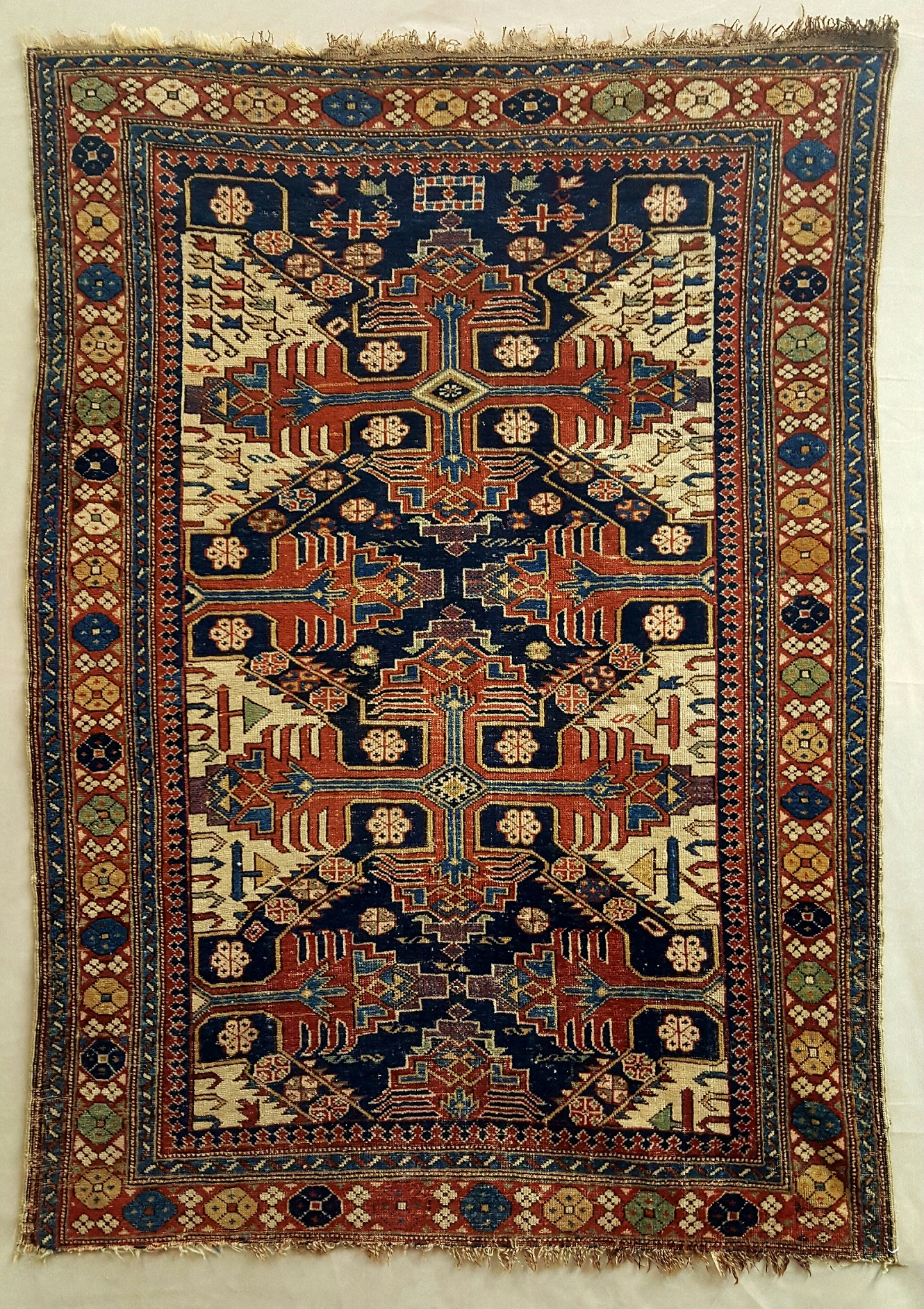
This is a rare antique Armenian Kuba rug from the region of Kuba, in the southeastern Caucasus, circa 1880s.


During the time when this rug was woven, the Armenian rug weavers and merchants, who lived in the vast area extending from the heartland of Anatolia to the shores of the Caspian Sea, had significantly contributed to the creation of magnificent rugs and their distribution to Europe and the United States. This explains why we encounter exquisite "Armenian rugs" woven in different regions and cities under such names as Anatolian, Kayseri, Konya, Sivas, Caucasian, Kazak, Karabagh, Shirvan, Kabistan, Kuba, and Daghistan. In addition to the superior quality of the wool and workmanship, the major distinguishing characteristics of Armenian rugs are the uniqueness and artistic execution of the designs. Although the patterns and motifs may seem familiar to rug connoisseurs, but their execution and composition, as well as the overall enchanting effects of those works of art are uniquely "Armenian." This Armenian Kuba rug is an superb example of all that. The cochineal-red medallions on the indigo-blue main field evoke the feeling that they were inspired by the designs of Eagle, Dragon, or Starburst Kazaks; closer examination reveals that a cross is placed in the center of each medallion. Also, the rosettes, palmettes, trefoils, and latch hooks are common in Caucasian and Persian rugs; but their combination and placements along with the color scheme reflect the "Armenian artistic taste."
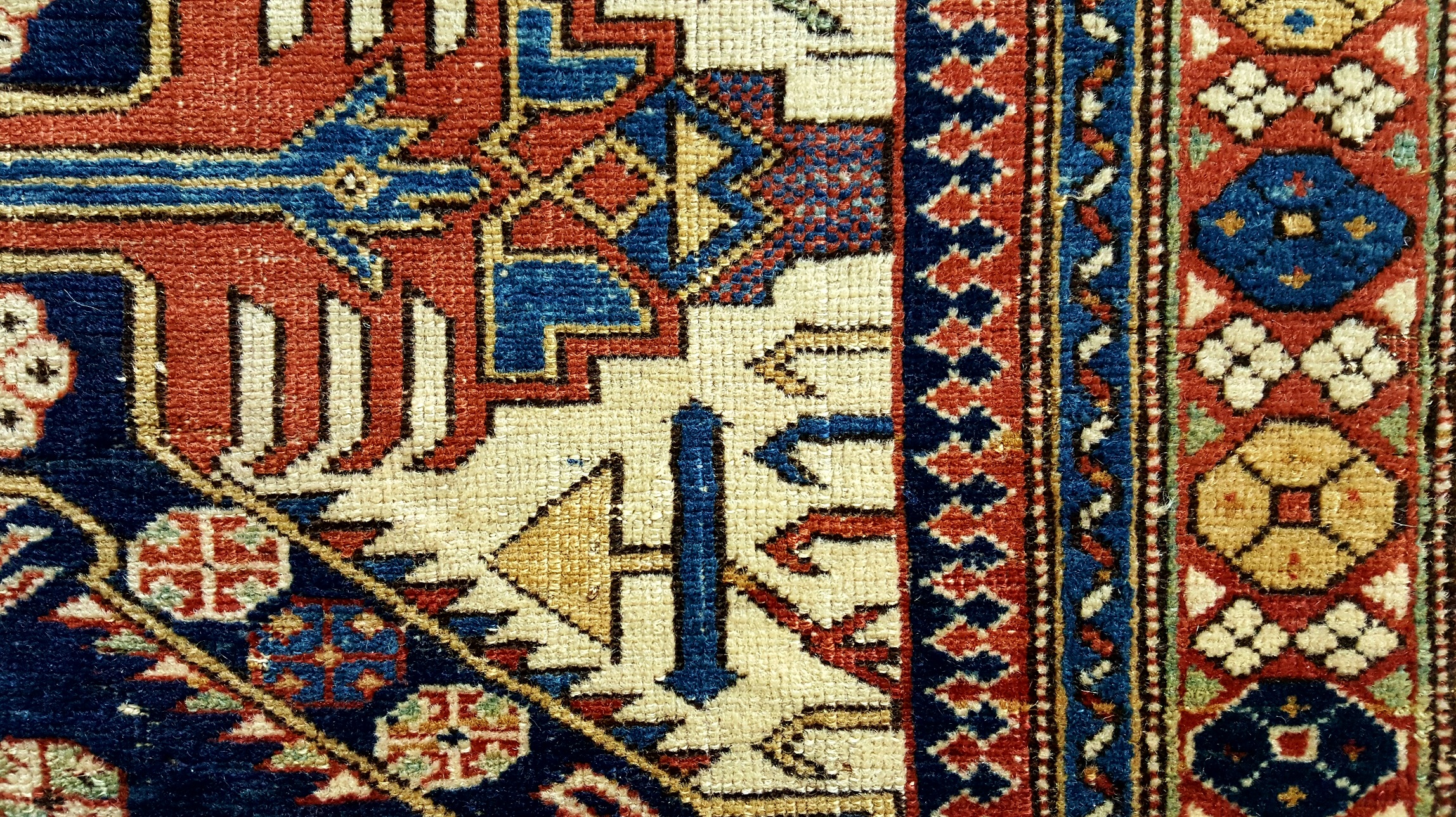
The ubiquitous use of natural undyed wool, especially on the main ground enliven the rest of the colors, which consist of red, blue, gold, light blue, and green. The primary red border is decorated with alternating one large and two small ivory rosettes. The large octagon-shaped repeated rosettes are woven in solid colors, all of which are used in the main field.


The inner and outer blue secondary borders are decorated with a continuously undulating vine pattern. The dog’s-tooth pattern reciprocating in red and blue surrounds the main field and symbolizes that this is also a garden-design, which is protected by a fence.


The uniqueness and artistic execution of the designs, the age, the rarity, and the condition of this magnificent rug make it a highly desirable work of art for sophisticated collectors and prestigious firms.
* * *
For more information about this exquisite rug, as well as for our ultimate expert service in hand cleaning and repair of your rugs, please contact Hayko by calling at  212-219-8257; (also 24-hour answering service at 212-717-5400); or by E-mail: info@hayko.com


Sincerely,

Hayko

Tuesday, August 23, 2016

Armenian Harvest Festival at UConn on September 17


Dear Friends,

I am pleased to inform you that the Norian Armenian Programs at the University of Connecticut will be hosting an Armenian Festival on Saturday, September 17, 2016. The following link provides the details about the program, the time, and the location:

http://armenia.uconn.edu/2016/06/30/09-17-2016-armenian-harvest-festival/ 


I will be one of the presenters in the featured activities demonstrating “The Art of Rug Weaving:” a hands-on workshop. My colleague from California, Hratch Kozibeyokian will be providing a concise introduction to Armenian Rugs.

With the thought that it would be an excellent cultural experience for anyone who might be interested to attend, I have decided to inform my friends of this Armenian Festival at the University of Connecticut.

Kindest regards,

Hayko

Monday, August 1, 2016

THE RUG OF THE MONTH (AUGUST 2016)

Dear valued Clients and Friends:
Thank you so much for your continued kind remarks and feedbacks regarding our "The Rug of the Month" messages. With great pleasure, I present to you our new "The Rug of the Month" for August.
QAZVIN (Persia) – Circa 1920s
11’ 8”  X  20’ 9”


If the term “Nomadic Rug” evokes images of care-free and charming composition of designs and colors, conversely, this exquisite Qazvin rug extols opulence and prestige.
Qazvin is situated in the northwest of the capital city of Tehran. During the Safavid dynasty, Shah Tahmasp made Qazvin the capital of the Persian Empire (1548), after the fall of Tabriz to the Ottomans. Of interest to us, that was the period when Qazvin also gained prominence as a major carpet-producing region through the encouragement of Shah Tahmasp.
Qazvin is also situated between Tabriz and Kashan. Therefore, it is natural to see the influence of both regions in designs and color schemes on Qazvin rugs. This is an exceptionally well-executed example of that concept. The intricate floral medallion and the cluster of floral designs in the four corners, as well as the combination of colors – especially burgundy and navy blue – are characteristics of Kashan rugs. The rest of the main burgundy ground is almost entirely covered by small precise floral designs, many of which form larger symmetrically-placed complex patterns that provide balance and harmony to the overall feel. Those repetitive small and intricate patterns, along with the ivory floral decorations on the navy-blue primary border and the red secondary borders are attributes of Kashan rugs.
We can discover numerous characteristics of this work of art to be mesmerized; however, I would suggest that you concentrate your attention to the ribbon of patterns surrounding the four edges of the main field. Although it is not a border, it gives the illusion of one. The use of celadon green makes it even more desirable. Further examination reveals that this precisely executed intricate ribbon of floral designs helps provide a magical balance and an artful elegance to the entire composition. Also, it provides a testament to the fact that this rug was produced by a small team of highly skilful artisans through their unwavering toil and commitment to excellence.
This Qazvin rug, which encapsulates the elements of the Tabriz and Kashan rugs and makes them its own with distinct artistic execution, is an exceptional piece of art to own for anyone who has the room to accommodate it – from a tastefully decorated home or office to a mansion or a museum.
* * *
For more information about this rug, as well as for our ultimate expert service in hand cleaning and repair of your rugs, please contact Hayko by calling at  212-219-8257; (also 24-hour answering service at 212-717-5400); or by E-mail: info@hayko.com. 

Sincerely,
HAYKO

Wednesday, July 6, 2016

THE RUG OF THE MONTH (JULY 2016)


Dear valued Clients and Friends:


Thank you so much for your exhilaratingly kind remarks and feedbacks regarding our "The Rug of the Month" messages. With great pleasure, I present to you our new "The Rug of the Month" for July. Enjoy!


TURKMEN TEKKE

4’ 1” X 4’ 6”


The Tekkes were the most important rug producers of the Turkmen tribes in the nineteenth century, when they inhabited in the region between the Caspian Sea and the Amu Darya River in Turkmenistan.


This is an exceptionally fine example of an antique Tekke rug. Despite its age, circa 1890s, the condition of this rug is superb. It is intact even with its original flat woven two ends.


The repeated typical Tekke gul design—the polygonal combination of curvilinear and geometric patterns that is also known as the generic Boukhara pattern—decorates the abrashed madder-red main field.


The most captivating characteristic of this rug is the harmony created by the combination of exquisitely intricate patterns in deep colors that decorate the primary border. Those consist of octagons with eight-pointed stars, latch hooks, combs, trees, and branches in dark red, brown, ivory, dark blue, pink, and plumb. The inner and outer secondary borders are decorated with continuous stylized yurt (tent) design in alternating colors and with two rows of small diamonds in ivory.


In addition to the primary and secondary borders, the two ends of the rug are decorated with clusters of diagonally placed serrated diamonds. Instead of being repetitious and boring, the alternate use and skillful placement of every color in the rug significantly enhance the overall charm of this artwork.


The uniquely artistic combination of designs and colors, the warmth of the finest wool with saturated natural dyes, the age and the excellent condition of this rug elevate it to the level of a rare gem for any tribal- or nomadic-rug rug collector.


                                                  * * *

For more information about this rug, as well as for our ultimate expert service in hand cleaning and repair of your rugs, please contact Hayko by calling at  212-219-8257; (also 24-hour answering service at 212-717-5400); or by E-mail:info@hayko.com.


Sincerely

HAYKO

Thursday, June 2, 2016

THE RUG OF THE MONTH

Dear valued Clients and Friends:

I am delighted to receive your kind remarks and valuable feedback regarding our “Rug of the Month” messages. With deepest gratitude I present the following “Rug of the Month” for June. Enjoy!

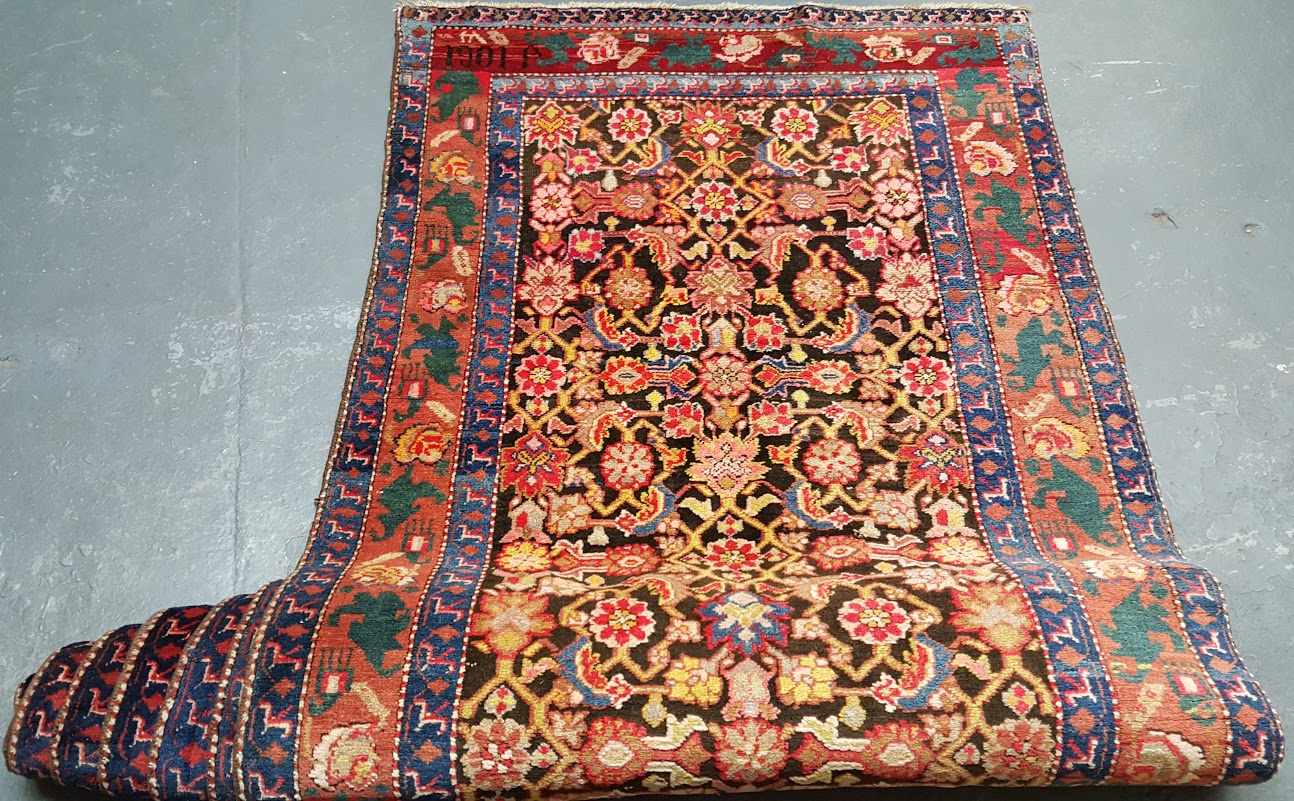
ANTIQUE KARABAGH RUNNER 3’ 9” X  14’ 4”
 
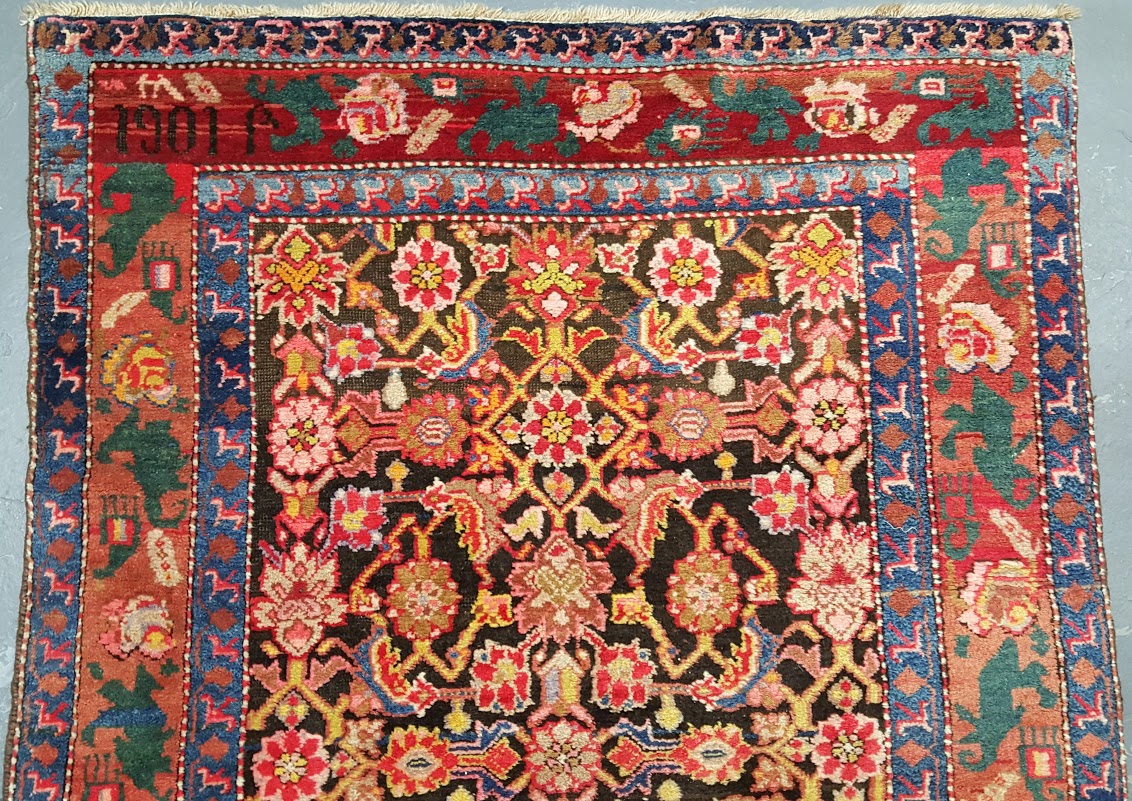
This exquisite Armenian Karabagh runner is dated 1901 and initialed in the Armenian letter “T.” The Caucasus region of Karabagh is located at the southeast of Armenia; and, is separated by the Aras River from northern Persia. In fact, it is about 80 miles from the Persian city of Tabriz, which had been a major market for the Karabagh rugs. Similarly, the Karabagh rugs had also been sought after in the European markets.

Despite this background, it is still surprising to see in this rug three major patterns, each of which with distinct Persian, French, and Caucasian characteristics. One cannot help but wonder for which market this rug had been woven. The abrashed-black main field is decorated with repeated Herati pattern of Persian origin. Secondary inner and outer blue borders are decorated with familiar trefoil flower and alternating vine leaf motifs. What makes this rug exceptionally desirable is its brick-colored primary border, which is decorated with Caucasian green dragon and multicolored quadruped, French Savonnerie/Aubusson flower head, and Persian lanceolate-leaf patterns.
 
Another noteworthy distinction of this rug is the experimental use of aniline red dye right below the date. The chemical garish red color looks distasteful next to the natural and deeply saturated Armenian cochineal red dye. However, around the time this rug was woven it was considered prestigious or fashionable to use chemical dyes although sparingly. Today, it helps us as a clear proof of why we value natural dyes. Incidentally, except for the sparingly used chemical red dye in flower and quadruped motifs, the rest of the natural dyes in blue, red, brick, yellow, ivory, green, pink, navy, and black in a varying range of from the deeply saturated to the light and abrashed shades further enhance the elegance of this charming artwork.

* * *

For morwe information about this rug, as well as for our ultimate expert service in hand cleaning and repair of your rugs, please contact Hayko by calling at  212-219-8257; (also 24-hour answering service at 212-717-5400); or by E-mail: info@hayko.com.

Sincerely,
Hayko

Monday, May 2, 2016

The Rug of the Month (May 2016)

Dear valued Clients and Friends:

It has been a distinct pleasure for me to receive so many of your kind remarks regarding our "Rug of the Month" for April. With deep gratitude, I present to you our new "Rug of the Month." Enjoy!

AFSHAR
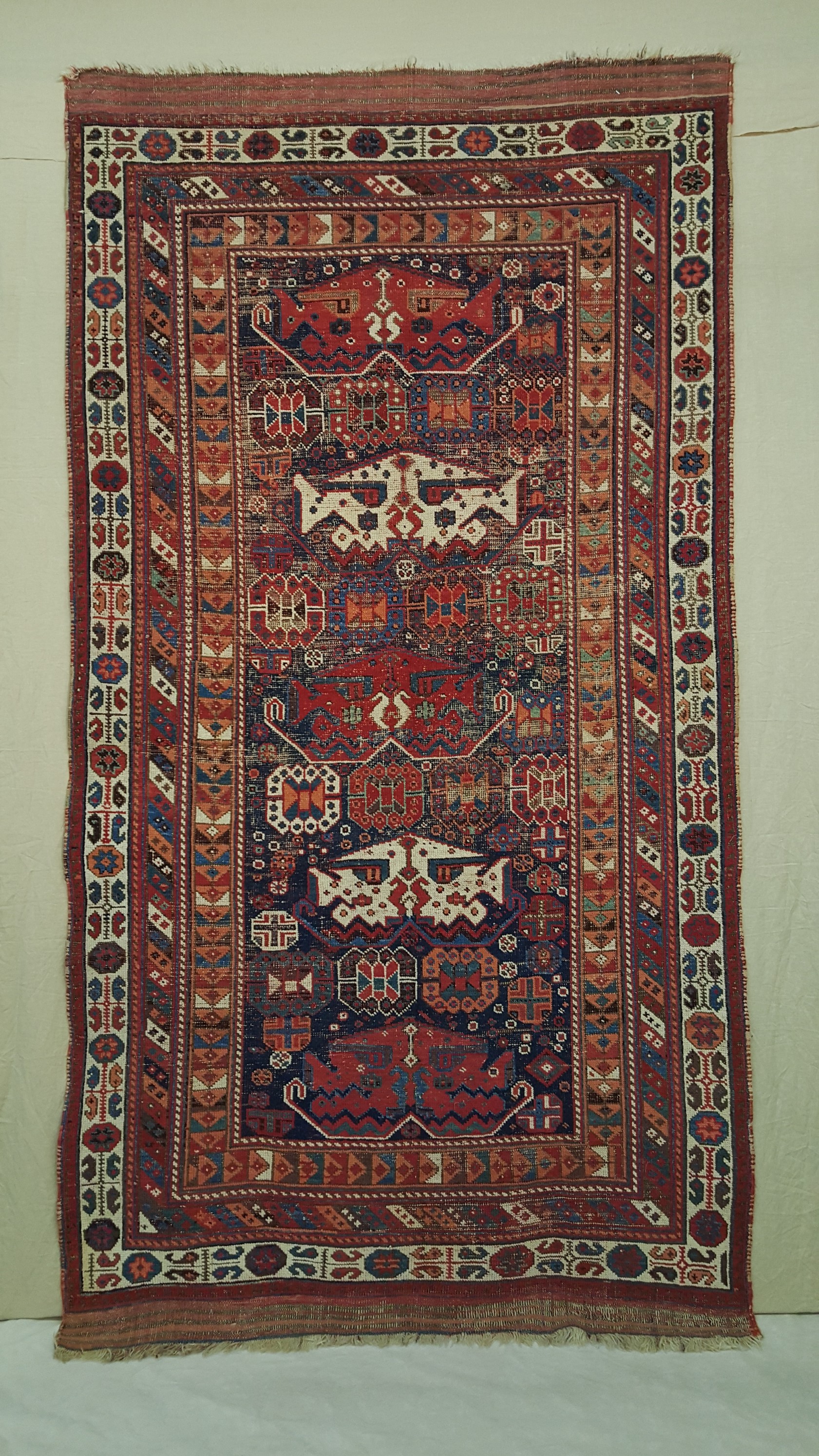
4’ 3” X 7’ 11”
 
This is a rare example of an Afshar antique rug, woven in the northern Persia by the industrious nomadic Afshar tribe. The Afshars, migrated and settled in various parts of Asia, the Caucasus, Persia, and Anatolia. As such, they adopted various patterns from those rug-weaving regions; and, refined them with their own aesthetics and artistry culminating in distinctive Afshar rug designs. 
 
This “Rug of the Month” is an exquisite example that exhibits those distinctive characteristics. Especially, the intricate but harmonious composition of the main field combines the sophistication of Persian stylized-floral designs with geometric Caucasian designs on an abrashed blue ground. For example, five repeated medallions are inspired by Persian patterns; and, the polygonal designs, angular rosettes, and crosses in octagons are typical of Caucasian and Anatolian motifs.  The magnitude of patters not only reveals the designs from different major rug-weaving regions, but also the artistic rendition of those creates an amazing harmony, which is further augmented with deep natural colors.
It has equally-balanced three primary borders, of which the outer one frames the entire composition of the rug. Also, a closer look at the outer ivory border also reveals that all of the colors used in the main field are utilized in the alternating motifs of four botehs and octagons containing eight-pointed stars.  The middle border with the repeated diagonal “barber-pole” pattern in alternating red, blue, rust, ivory, turquoise, brown, black, colors shows the characteristics of a Caucasian Shirvan rug. The inner border also is decorated with the same color scheme in repeated angular vine pattern of Caucasian origin.
It was woven in circa 1880s; yet, it has never been repaired. Moreover, although its fine woolen pile is evenly worn due to the ravages of time, the rug still remarkably retains its integrity complete with the flat-woven sections at the both ends, as well as the original overcasts on the two sides.  This tribal, yet rare and spectacular, Afshar rug represents an exceptional value as a collector’s or a museum piece.
* * *
For further information about this rug, as well as for our ultimate expert service in hand cleaning and repair of your rugs, please contact Hayko by calling at  212-219-8257; (also 24-hour answering service at 212-717-5400); or by E-mail: info@hayko.com.

Sincerely,
Hayko